








Zero Egress, One Governed Model: How Rexel Consolidated 7–10 ERPs on Snowflake
Rexel USA’s VP of Analytics on building governed, agent-ready master data without ever moving it outside Snowflake.
Share this post


Guest Speakers
From Rexel USA and Snowflake, hosted by Semarchy.



Get instant access to the webinar
Webinar Summary
~30M
golden records
targeted across Products, Suppliers, Customers, Sites & Finance
7–10
ERP systems
consolidated into one governed model, natively on Snowflake
~1
per quarter
Pace of M&A driving the need for a unified data strategy
How Rexel Keeps Every Customer Straight Across a Fragmented ERP Landscape
Rexel USA has spent the last five years growing almost entirely through acquisition, picking up a new company nearly every quarter. Nobody there would call that a data problem. It became one anyway.
James Wilson Jr., known to everyone on the call as “Wilson,” was brought into Rexel USA a couple of years ago specifically to rebuild the infrastructure behind that growth: part analytics, part solutions, all aimed at getting the company’s next generation of systems in place. He walked through that work alongside Prabhath Nanisetty, who advises companies across the industry on data and AI strategy at Snowflake, in a conversation hosted by Semarchy’s Benny Garner. None of them frame this as a finished project. It’s a multi-year build, and they’re only three to four months into the governance structure alone, but the shape of it is already clear.
Growth by Acquisition Breaks Data Before It Breaks Anything Else
Rexel’s growth math is almost entirely additive: roughly one acquisition every quarter, on top of organic growth, split across commercial (63%), industrial (30%), and residential (7%) customers. Each new “banner” (that’s Rexel’s term for its distinct operating divisions) arrives with its own customer relationships, its own supplier terms, and often its own instance of whatever ERP it was already running. Wilson named Eclipse specifically as the system most banners run, but even within Eclipse, “it’s almost like a separate ERP” instance by instance.
Consolidating onto one shared ERP was on the table and was explicitly ruled out: with a new banner arriving roughly every quarter, an ERP migration would compete directly with the M&A pace itself, and risk disrupting the relationship-driven sales model Rexel depends on. Rexel’s actual choice was to leave transaction systems alone and consolidate the data layer above them instead.
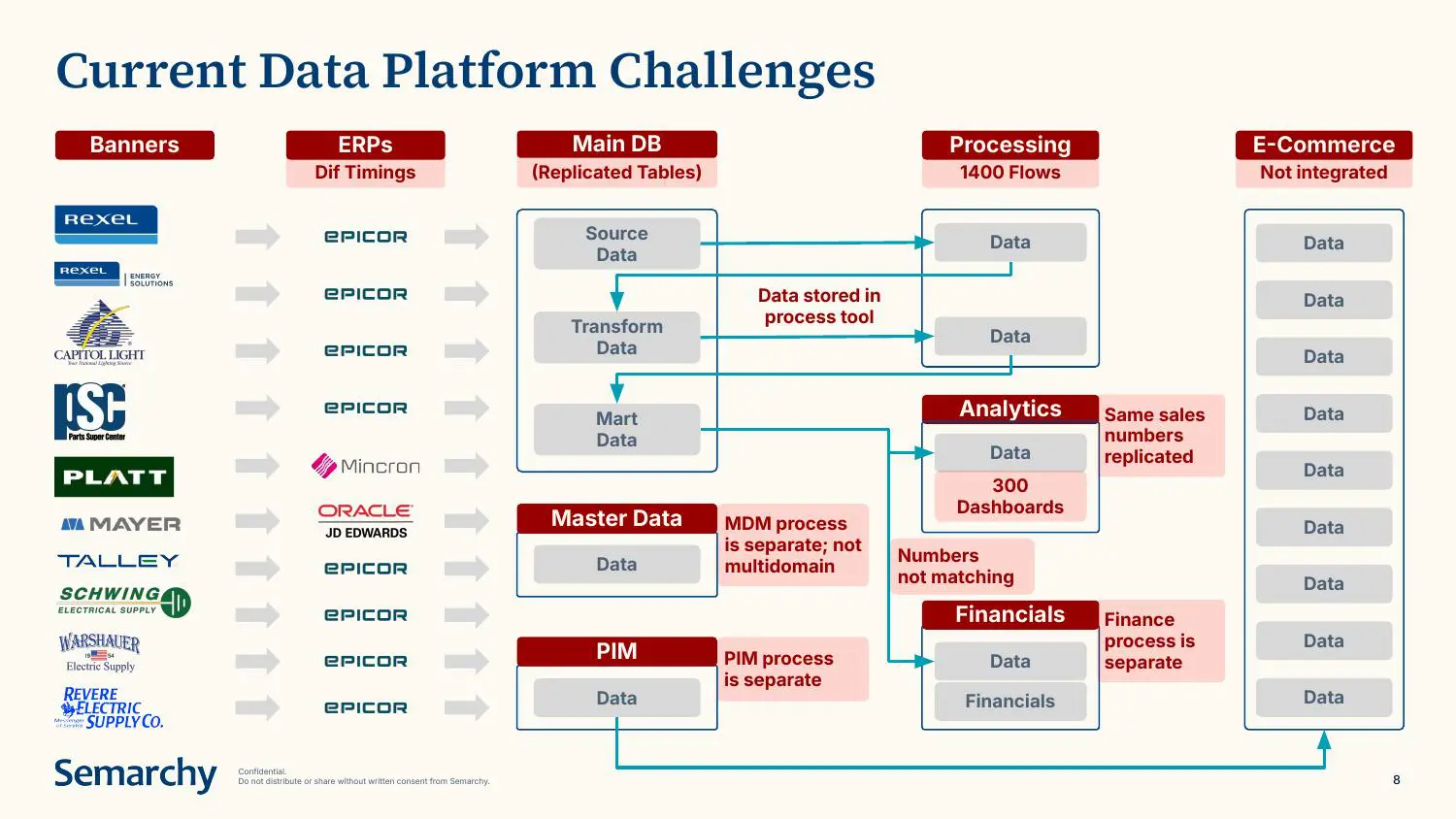
Figure: The platform Rexel was actually running before this program — ERPs feeding a database of replicated tables through 1,400 processing flows, with MDM, PIM, and Finance each running as their own separate process and e-commerce not integrated.
Why Native-on-Snowflake Beats Bolt-On MDM
That data layer needed a home, and Rexel was as deliberate about where it lived as it was about leaving the ERPs alone. The requirements going in were specific, not aspirational: 30 million golden records across Products, Suppliers, Customers, Sites, and Finance, mastered for 7–10 ERPs, running natively inside Snowflake rather than in a separate MDM vendor’s cloud. That last part wasn’t a preference. Keeping master data inside the same platform as the raw data means zero egress, one security perimeter to defend, and no new data movement to explain in a security review.
“Their implementation strategy is one of the best I’ve ever dealt with. We never had to get an outside partner to help us implement MDM.”
— James “Wilson” Jr., VP of Analytics and Enterprise Solutions, Rexel USA
The build reflects that architecture choice. Rexel mastered five domains in under four months, without bringing in an outside systems integrator. Once a record changes, it moves fast enough to matter operationally: pricing updates across 100,000 SKUs land in under four hours, the UI refreshes in under two seconds, and new records distribute to downstream systems inside a five-minute SLA. None of that is achievable if master data has to leave Snowflake and come back. Getting that architecture right, though, turned out to be the easier half of the project.
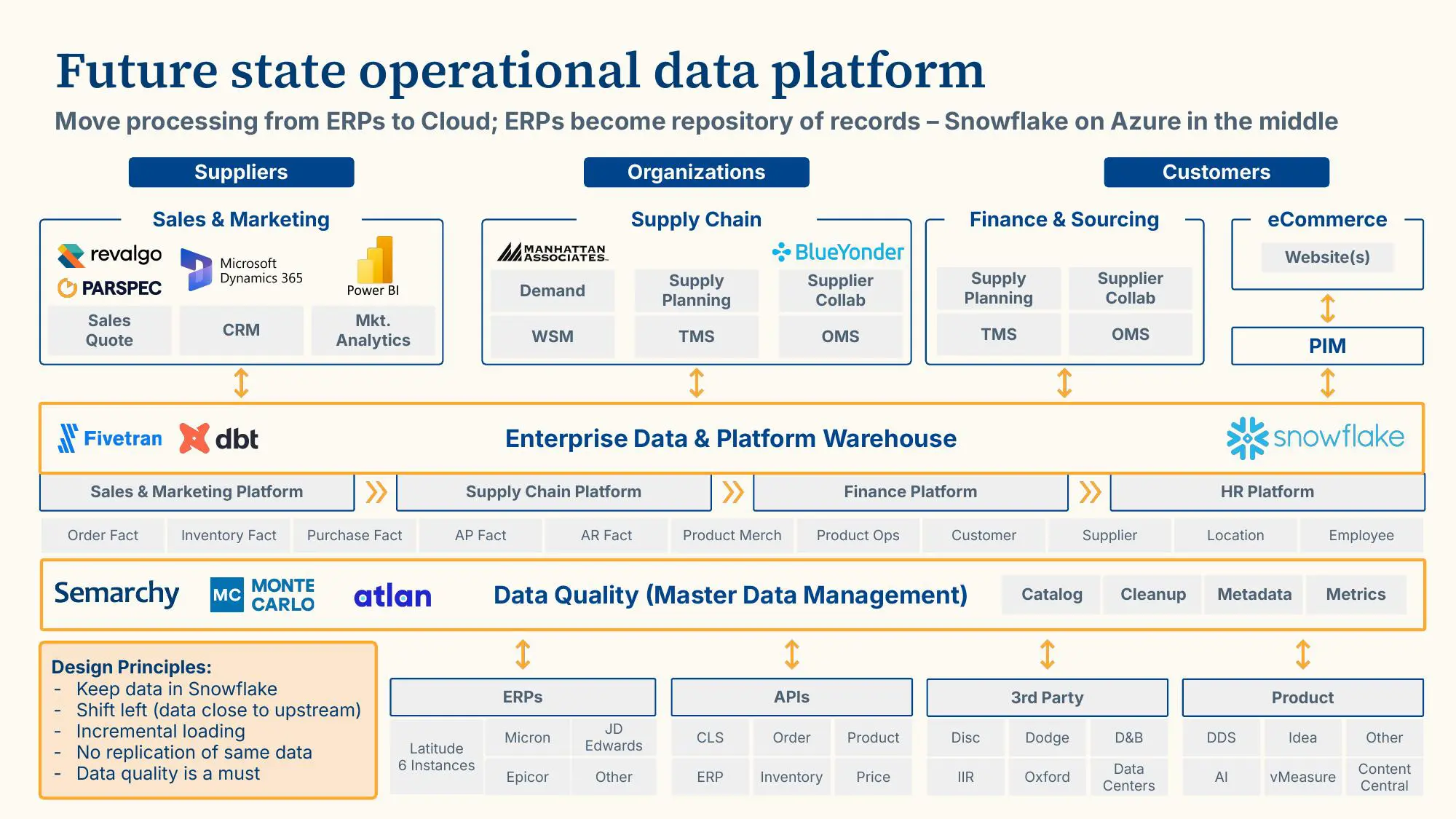
Figure: Rexel’s future-state operational data platform — ERPs, APIs, third-party feeds, and product sources flow into a Snowflake-based Enterprise Data & Platform Warehouse, governed by Semarchy for data quality/MDM.
The Technology Wasn’t the Hard Part: Defining “a Customer” Was
“The technology wasn’t hard. It’s sitting down now that you have the technology and aligning the business to a single definition of master data — that’s where we spent a much greater part of our time than the actual mastering itself.”
— James “Wilson” Jr., VP of Analytics and Enterprise Solutions, Rexel USA
The governance structure alone took three to four months to line out. The concrete example Wilson kept coming back to: getting the business to agree on what actually counts as one Rexel customer, a question that sounds trivial and wasn’t, took three weeks of real negotiation to resolve in a way that worked for both Snowflake and Semarchy MDM. The same exercise repeated for “product,” walking through manufacturer, brand, product, supplier, and domain definitions one at a time. That groundwork is what the next layer, the one Rexel is building for AI, depends on entirely.
Governed Master Data Is the Layer That Keeps AI From Hallucinating
“Everyone focuses on AI — Claude, Copilot, all these solutions. In my mind, when it’s all said and done, it’s the semantic layer you build inside of Snowflake with the master data. That’s what you put your AI on top of. If you don’t have that specific combination… your AI is going to hallucinate and not be successful.”
— James “Wilson” Jr., VP of Analytics and Enterprise Solutions, Rexel USA
Prabhath Nanisetty’s addition from the Snowflake side centers on interoperability. Rather than one vendor owning every layer, Snowflake’s model is to let organizations bring in best-of-breed partners (Semarchy for master data, Atlan for context and lineage) directly to where the data already lives, governed under one centralized layer Snowflake calls the Horizon Catalog. That catalog is what lets a human, a dashboard, an AI agent, or an agent talking to another agent all draw from the same governed source instead of each rebuilding trust in the data from scratch.
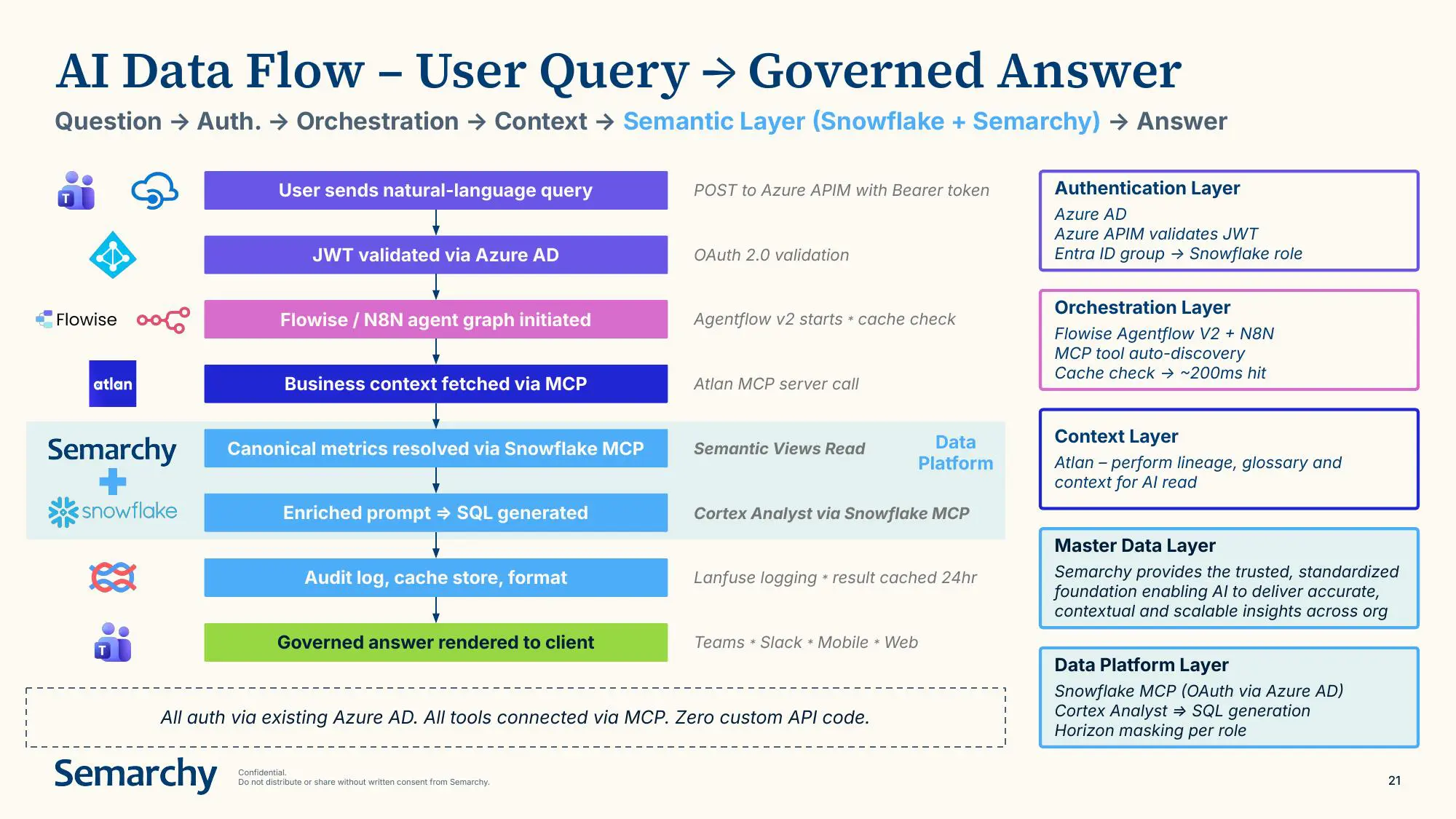
Figure: The AI Data Flow architecture Wilson and Prabath describe — a natural-language question moves through authentication (Azure AD), orchestration (Flowise/N8N), business context (Atlan), and a semantic layer pairing Snowflake’s Cortex Analyst with Semarchy’s mastered records, before a governed answer returns to the user.
“No matter what comes after AI and agents, the most important thing companies have as a strategic advantage is their data and how they operationalize it.”
— Prabhath Nanisetty, Industry Leader for Technology and AI, Snowflake
Prabhath’s own closing advice was blunt: enterprises have been “kicking data quality down the road” for 20 or 30 years, and that runway is gone. Rexel’s approach, consolidating the master data layer natively inside the platform it already runs on before chasing the next AI initiative, is as much an argument about sequencing as it is about architecture. Watch the full conversation above, or jump to the moments below.
Key Moments From the Conversation
Related Resources
From blog posts to product guides and everything in between, we’re here to help you along your data journey.

Snowflake MDM Native App
Snowflake SDP Connected App
Bridge the AI-Data Gap: Build Trusted Data Foundations with Snowflake + Semarchy