






Designing Trusted, Scalable, Agent-Ready Data Models for Retail & Supply Chain
Rexel’s VP of Analytics explains why his team walked away from a full ERP consolidation — and what it took instead to get a governed data model live on Snowflake.
Share this post





Get instant access to the webinar
Webinar Summary
15M
electrical SKUs
in the marketplace Rexel tracks (~6M mastered so far)
~30M
golden records
targeted across the mastering program
7–10
ERP systems
being consolidated into one MDM layer
How Rexel Is Turning 15 Million SKUs and 10 Business Units Into One AI-Ready Data Model on Snowflake
Rexel USA has spent the last several years doing something most companies try to avoid: growing almost entirely through acquisition. Since around 2020, the electrical distributor has gone from roughly $4 billion in revenue to $8.2 billion today, adding a new “banner” — Rexel’s term for its operating divisions and store brands — roughly once a quarter. Every acquisition arrived with its own customers, suppliers, and ERP system — none built to talk to the others.
By 10 banners, 750-plus suppliers, and a slice of the 15 million SKUs in the marketplace, that growth had created a quieter problem: nobody could agree on basic facts about the business. James “Wilson” Jr., Rexel USA’s VP of Analytics and Enterprise Solutions, built a fix with Snowflake and Semarchy that left every ERP in place and reconciled the data between them.
How A Box of Pop-Tarts Settles MDM vs. PIM
The obvious fix for ten divisions on different systems: force them onto one. Rexel considered it — JD Edwards and SAP came up as candidates — and rejected it: consolidating ERPs while onboarding a new acquisition every quarter felt like repeatedly changing the tires on a moving car. Wilson describes the blind spot that decision left behind bluntly: “it’s very invisible what’s going on between Revere, Rexel, and Platt.” A sales rep at one banner had no way of knowing whether the same customer down the street already belonged to another. Multiply that across ten banners, and Rexel wasn’t running one business — it was running ten loosely federated ones sharing a name.
“It’s very invisible what’s going on between Revere, Rexel, and Platt.”
— James “Wilson” Jr., VP of Analytics and Enterprise Solutions, Rexel USA
The mechanics behind that blind spot were just as tangled: ERP data ran through roughly 1,400 processing flows into a database of replicated tables, with sales figures differing across roughly 300 downstream dashboards.
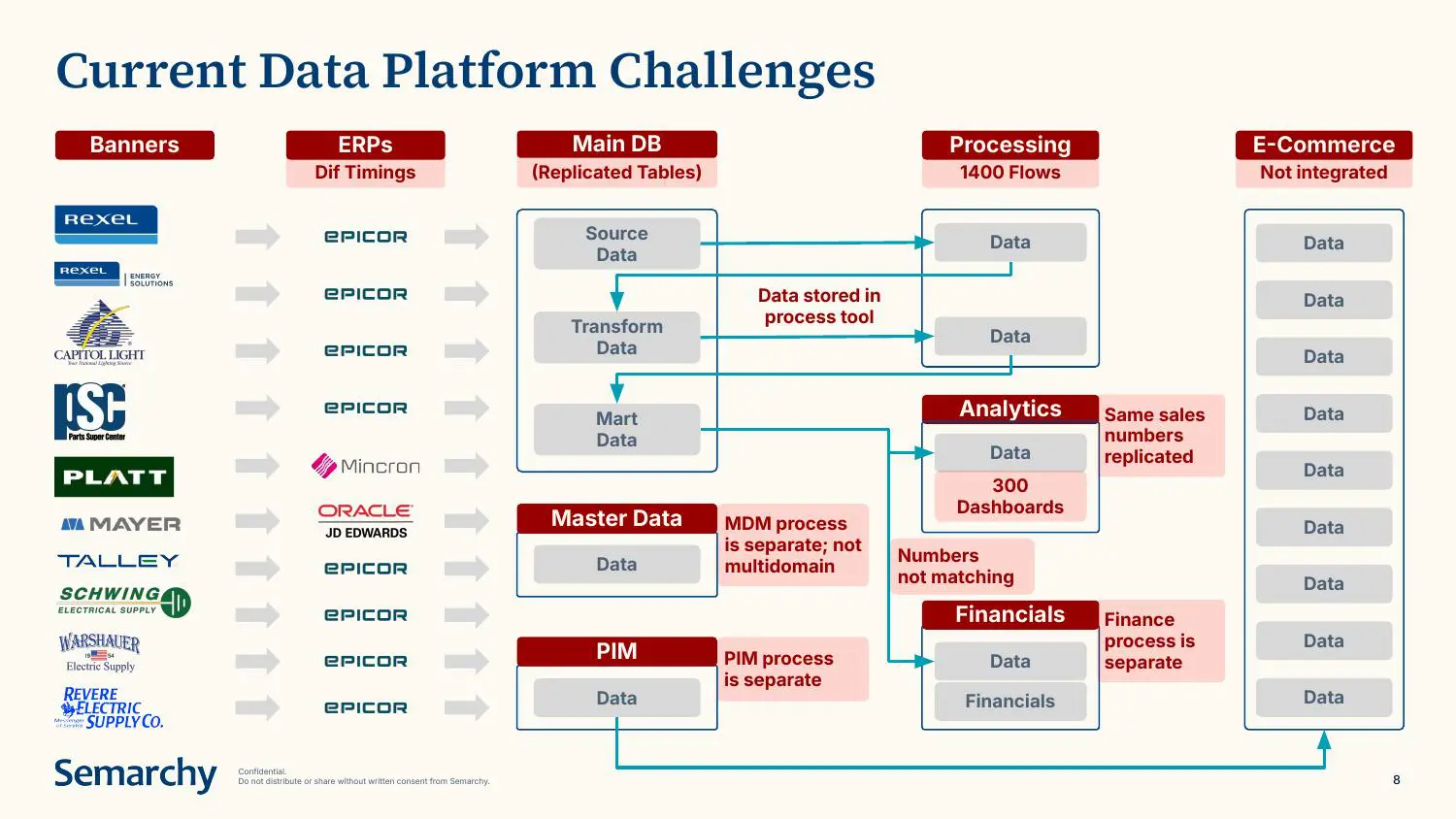
Figure: The platform Rexel was actually running before this program — ERPs feeding a database of replicated tables through 1,400 processing flows, with MDM, PIM, and Finance each running as their own separate process and e-commerce not integrated.
How A Box of Pop-Tarts Settles MDM vs. PIM
The next decision was less about infrastructure than sequencing. Rexel already had Syndigo in place for product content — a PIM system — so the open question was whether to lead with better content or build a master data management (MDM) layer first. Wilson settled it for his team with a box of Pop-Tarts. Look up the same brown-sugar-cinnamon Pop-Tart on Amazon, Walmart, and Target, and you’ll find three different titles, images, and descriptions for the identical product.
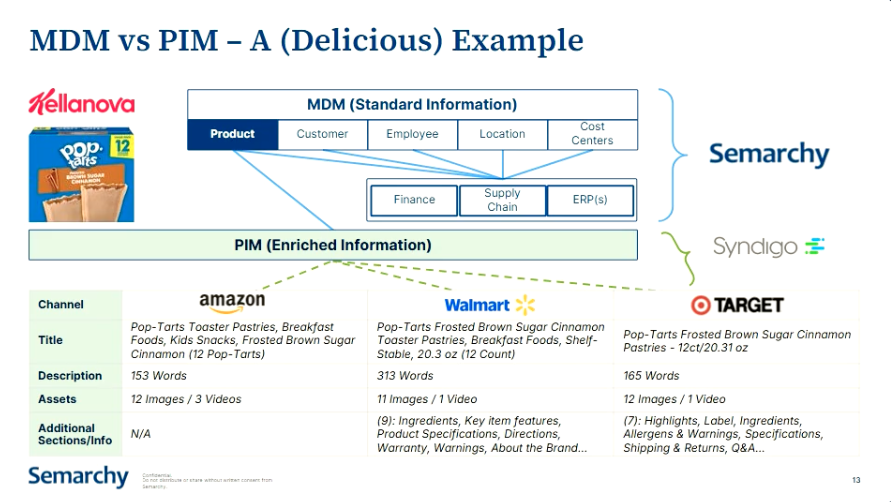
Figure: The same Pop-Tart, three different listings — one governed MDM record standardizes product, customer, location, and cost-center data; PIM then tailors that record per channel: Amazon’s listing runs 153 words with 12 images and 3 videos, Walmart’s runs 313 words with 11 images, and Target’s runs 165 words with 12 images and its own set of additional sections.
That’s PIM, tailoring one item to different channels. But underneath all three listings, there has to be one item everyone agrees is the same thing. That’s MDM. “I don’t think it’s either/or,” Wilson says. “I think you will be using both.” Rexel built MDM first, then fed the standardized data into PIM — rather than enriching content nobody had reconciled yet.
Building Where the Data Already Lives
The scale was substantial: roughly 30 million golden records across seven to ten ERPs, covering products, suppliers, customers, locations, cost centers, and assets. Rather than standing up a separate platform and shuttling data back and forth, Wilson’s team kept everything inside Snowflake, where Semarchy’s certification engine runs directly. Wilson compares it to how dbt processes data, not a black box. The payoff shows up in what Rexel avoided as much as what it built: no egress costs and no second security model to maintain. Prabath Nanisetty, Snowflake’s industry leader for technology and AI, sees this native-in-Snowflake pattern becoming the default across the industry, not just at Rexel.
The model also has to handle relationships across domains, not just within them — flagging, for instance, which products serve industrial customers versus healthcare customers, so the two stay linked rather than siloed.
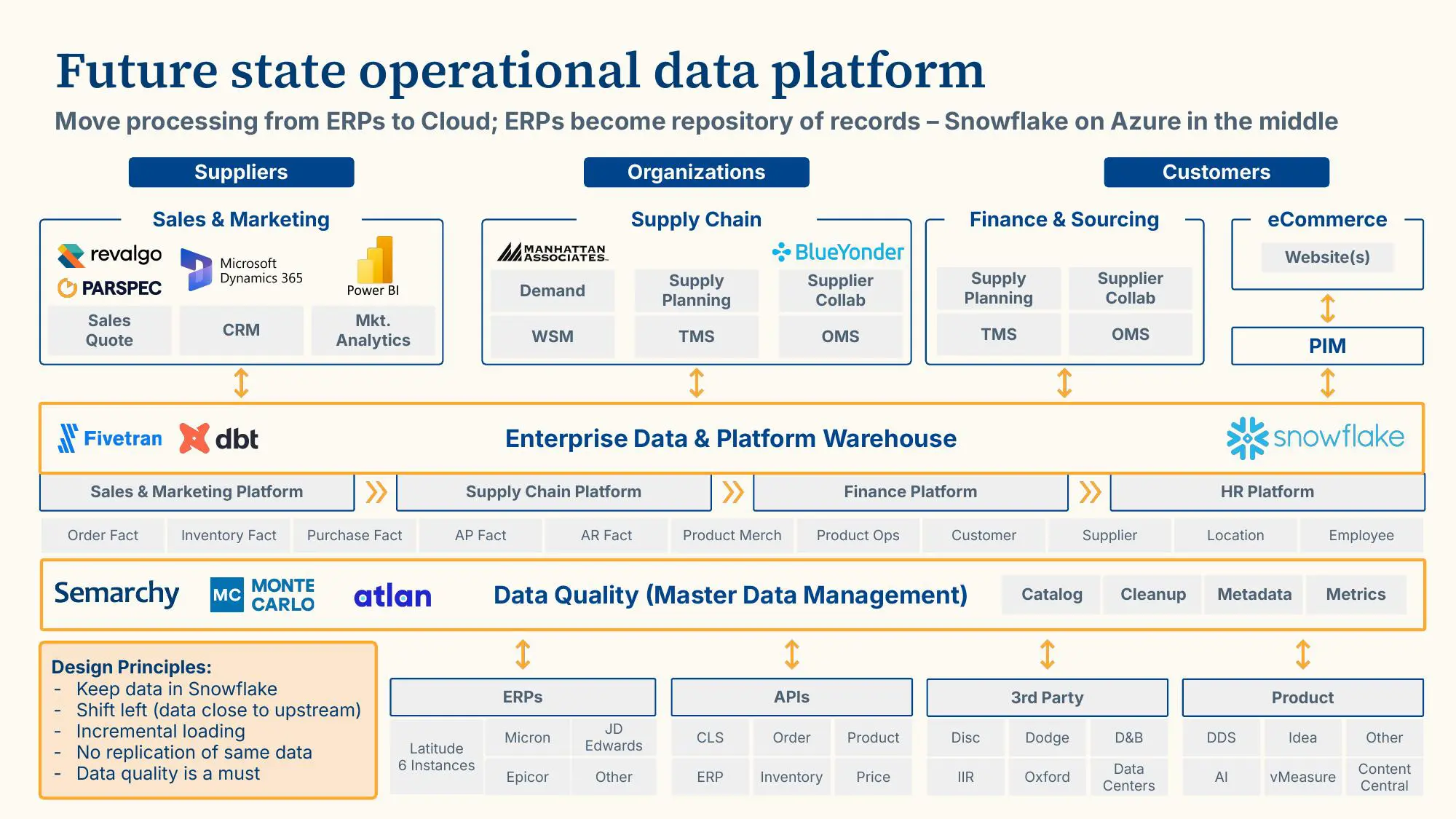
Figure: Rexel’s future-state operational data platform — ERPs, APIs, third-party feeds, and product sources flow into a Snowflake-based Enterprise Data & Platform Warehouse, governed by Semarchy for data quality/MDM.
The Real Work Was Agreeing What “Customer” Means
Ask Wilson what actually took the most time, and the answer isn’t a piece of software. “The technology wasn’t hard,” he says. “It’s aligning the business to a single definition of master data.” Governance alone took three to four months to stand up. The matching rules themselves were concrete: the same manufacturer part number showing up under Rexel, Platt, and Mayer had to resolve to one golden record, not three.
But before any of that could run, Rexel had to answer an almost absurd question: what is a customer? It took three weeks — not to build anything, but to agree on a definition specific enough to satisfy both Snowflake and Semarchy, and general enough to hold across all ten banners. Rexel then repeated the exercise for product, manufacturer, brand, and supplier.
“The technology wasn’t hard. It’s sitting down now that you have the technology and aligning the business to a single definition of master data — that’s where we spent a much greater part of our time than the actual mastering itself.”
— James “Wilson” Jr., VP of Analytics and Enterprise Solutions, Rexel USA
The implementation itself, by contrast, was the easy part — one of the best Wilson’s dealt with, done without an outside systems integrator, on Semarchy’s own training and support.
What It Was All For
None of this — the rejected ERP consolidation, the Pop-Tart analogy, the months of governance meetings — reads like an AI strategy on paper. But by Wilson’s account, it is one. His framing for what separates a reliable AI system from a hallucinating one is a specific combination: a semantic layer built inside Snowflake, powered by Semarchy’s master data, working alongside Atlan’s context layer. Miss any piece of it, he argues, and “your AI is going to hallucinate and not be successful.”
“Everyone focuses on AI — Claude, Copilot, all these solutions. In my mind, when it’s all said and done, it’s the semantic layer you build inside of Snowflake with the master data. That’s what you put your AI on top of. If you don’t have that specific combination… your AI is going to hallucinate and not be successful.”
— James “Wilson” Jr., VP of Analytics and Enterprise Solutions, Rexel USA
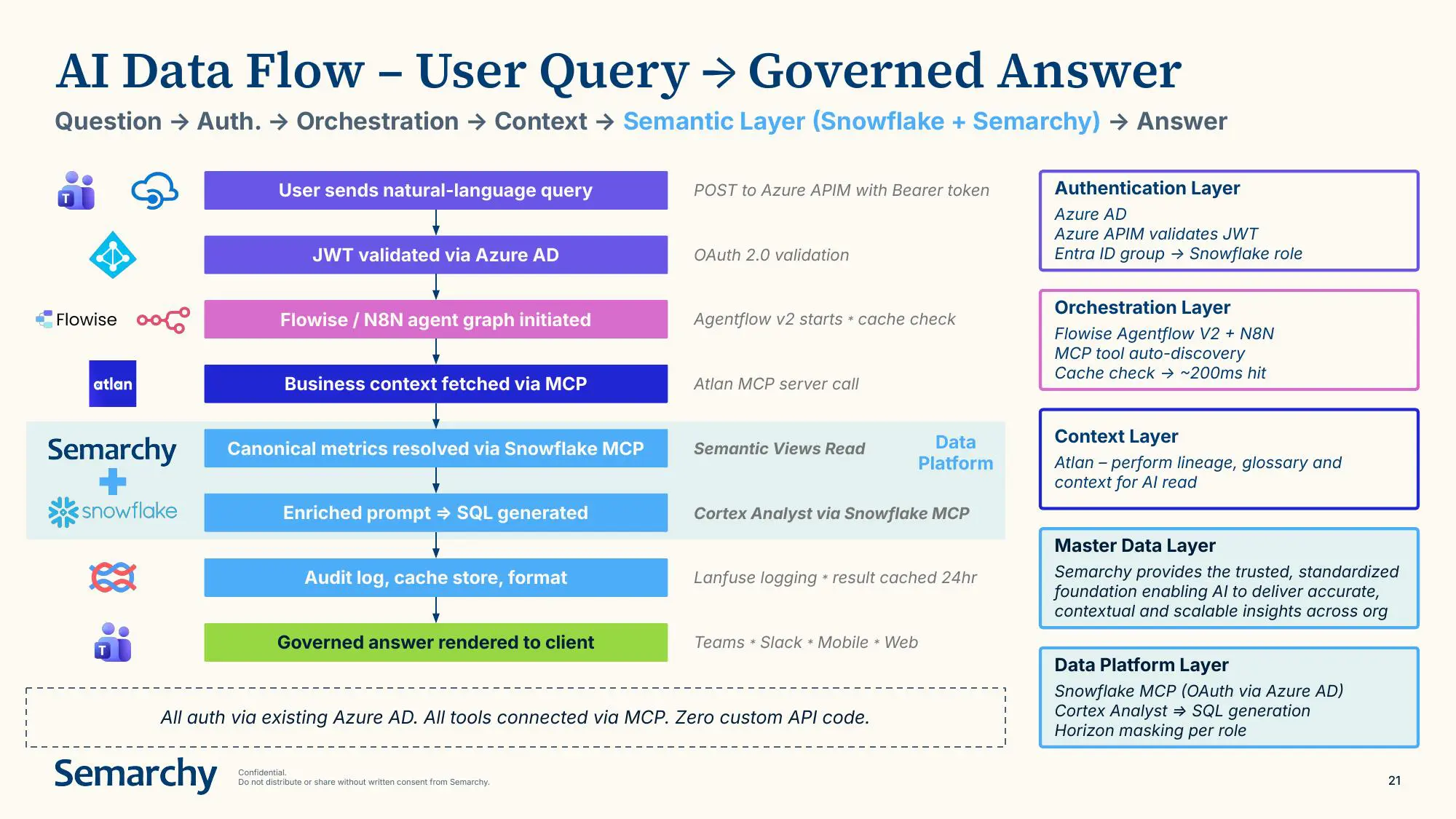
Figure: The AI Data Flow architecture Wilson and Prabath describe — a natural-language question moves through authentication (Azure AD), orchestration (Flowise/N8N), business context (Atlan), and a semantic layer pairing Snowflake’s Cortex Analyst with Semarchy’s mastered records, before a governed answer returns to the user.
Three years ago, Rexel was a $4 billion company running ten increasingly disconnected businesses under one name. Today its data foundation is built to answer a much bigger question than “who is this customer” — it’s built to be the thing an AI agent can trust when someone asks. Watch the full session above for the architecture walkthrough, or reach out to talk through what a similar foundation could look like for your own ERP landscape.
Key Moments From the Conversation
Related Resources
From blog posts to product guides and everything in between, we’re here to help you along your data journey.

Snowflake MDM Native App
Snowflake SDP Connected App
Bridge the AI-Data Gap: Build Trusted Data Foundations with Snowflake + Semarchy